F1Weekly Podcast # 1135
…ON TODAYS PROGRAM…
FERNANDO AND THE HONDA CURSE, LAWRENCE STROLL SELLS ASTON MARTIN NAMING RIGHTS FOR 50 MILLION POUNDS.
FERRARI ON THE OTHER HAND SHOW OFF NEW SPINNING REAR WING AND, LOOK VERY COMPETITIVE !
MCLAREN AND MERCEDES ARE NOT FAR BEHIND…
RED BULL IS STILL A QUESTION MARK?…AND
FERNANDO WILL NEED HIS CAMPING CHAIR AS THE GP2 ENGINE THAT FAILED HIM AT MCLAREN, THAT WENT KABLAMO IN THE INDY 500 AND LOOKS TO HAUNT ALONSO FOR ANOTHER LONG SEASON!! STAY TUNED FOR SOME GREAT ONE LINERS FROM MACHISMO…
THIS WEEK’S NASIR HAMEED CORNER…MORE VINTAGE BANTER BETWEEN THE HOST AND NASIR…THIS WEEKS SPECIAL GUEST: MARCUS ERICSSON, MARTIN BRUNDLE, AND MIKI MONRAS DE ESPANA…!

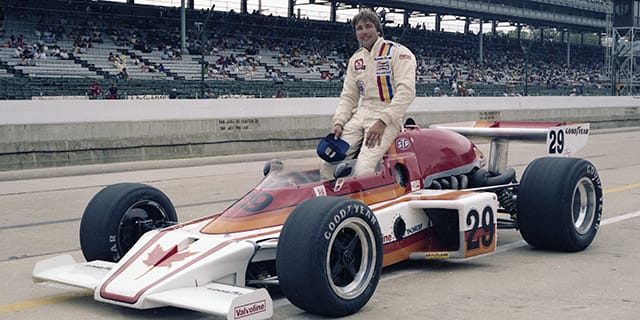
Indianapolis 500 Veteran Hucul Dies at 79
INDIANAPOLIS (Friday, Feb. 20, 2026) – Canadian driver Cliff Hucul, a veteran of three Indianapolis 500 starts in the late 1970s, died Feb. 17 on his farm in his native Prince George, British Columbia. He was 79.
Hucul made three consecutive starts in “The Greatest Spectacle in Racing” from 1977-79.
His best finish came as a rookie in 1977, 22nd in the No. 29 Team Canada McLaren/Offenhauser that Hucul bought after Johnny Rutherford drove it to victory in the 1976 “500.” Hucul completed 72 laps before being sidelined by gearbox problems. He qualified on Bump Day for that race despite touching the wall in practice the previous day and suffering two engine failures during the Month of May, a significant pitfall for his low-budget team.
Hucul’s best qualifying spot was 18th in 1979, his final “500” start.
The small-town driver from northern British Columbia learned his craft by racing stock cars and modified sprint cars at local tracks. He then began racing modifieds and supermodifieds in the Pacific Northwest against drivers that included eventual Indianapolis 500 winner and INDYCAR SERIES champion Tom Sneva and his brother Jerry Sneva.
Hucul made 24 total USAC and CART starts between 1977-81, with eight top-10 finishes. Hucul’s best finish in the standings was 11th in 1979, when he started the season by placing fifth at Ontario Motor Speedway and a career-best fourth at Texas World Speedway.
In 1996, Hucul became a paraplegic after an automobile accident when crossing black ice on a highway in British Columbia. Despite being confined to a wheelchair, Hucul remained active, managing his farm and mentoring many drivers in the area. He was inducted into the Prince George Sports Hall of Fame for his lifetime contributions to auto racing.
Hucul is survived by his son, Kelly, and daughter-in-law, Sylvie; daughter, Michele, and many grandchildren.
2026 BAHRAIN TESTING – WEEK 1, DAY 3

MAX VERSTAPPEN
“Looking at the test overall, the Team got in a good number of laps on the first day so we were happy with that. We completed a lot of things that we wanted to test with the new Power Unit and the car in general. Today it was a continuation of that plus also trying to explore a little bit more with the car; you go through so many test items that it continues to change and evolve with everything that you are testing. In general, it is all so new that we are still learning a lot, but the car was good. We also have new tyres, so we spent some time looking at different sets and understanding what we need to improve and be better at. With the power unit, looking at the laps we got on the board, the start that we have had is good. That’s exactly what we wanted to do and it was not a given. Whether it will be enough to win races, we don’t know, we will just focus on ourselves and try to do the best we can, but there is still massive room for improvement. Finally, with the car, we learnt a lot about what worked and what didn’t. Our runs also gave us even more ideas for the afternoon with Isack and then for next week, where we can continue to try new things and different set ups.”

ISACK HADJAR
“The first week here in Bahrain has gone well. Of course, I had to wait a little before getting in the car after Barcelona, but once I did, we were able to put it to the test and really work through what we need ahead of next week and Melbourne. There are so many things to look at, but we’re staying on track with our programme so far. True performance and pace are always hard to judge in pre-season, but we can be happy with the reliability we’ve had from the power unit this week. There are still things to work on in terms of balance and tyre management, but that’s completely normal for this time of year. We’re working through it together as a Team to get where we want to be for Australia. I’ve known the people here for a while now, but it’s great to be working with them again in an environment like this.”

ASTON MARTIN
The Aston Martin Aramco Formula One™ Team concluded its testing programme at the Bahrain International Circuit today, with Lance Stroll returning to the cockpit of the AMR26 for the final time before the Australian Grand Prix.
Lance did not get on track until late in the morning session due to a battery-related issue that had impacted Fernando’s running yesterday. Honda carried out simulations on the test bench at HRC Sakura before the car returned to the track. Due to a shortage of power unit parts, the run plan was very limited and consisted only of short stints.
Lance Stroll
“It’s been a challenging couple of weeks here in Bahrain, and today’s limited running wasn’t the way we wanted to finish the second test. It’s clear the car isn’t where we want it to be performance-wise, and we know there’s a lot of work ahead in the coming weeks and months. There’s a long season ahead, and we’ll keep pushing flat out to unlock more performance.
I want to say a big thank you to everyone trackside and back at the AMRTC for the work that’s gone in so far. It’s not where we want to be right now, but I know how determined this team is. We’ll stick together, rise to the challenge and keep working until we deliver the performance we are looking for.”

WILLIAMS F1 2026 Bahrain pre-season testing – Day 3
James Vowles, Team Principal: Another solid day of running and mileage. It’s great to see that across the last six days of testing, we’ve been predominantly tyre and time limited, and able to complete the full programme that we wanted. That’s just a testament to the hard work of the teams, both here and in Grove, making sure that we made up for lost time.
No one truly knows where all the performance lies. That’s what Melbourne is all about, so I can’t wait to go there, to gain a further understanding of where we are. What I know for sure, though, is we have work to do. There’s no doubt about it. We’ve put ourselves on the back foot. But my assurance to everyone is that we have an aggressive programme lining up in front of us in order to make sure that we extract as much performance in this car as possible over the forthcoming months.
Carlos Sainz: The past six days of testing in Bahrain has been one of the most interesting and challenging tests that I’ve been part of, given the new regulations and number of things we had to learn. The progress from day one has been significant, although there are still going to be things to understand and solve at the start of the season.
We go into the first half of the year with lower expectations than 2025 knowing that we’ll be starting slightly on the back foot. However, I’m really looking forward to getting started and focusing on improving the cars through the year to become more competitive. Bring on Melbourne!
Alex Albon: It’s been a relatively smooth test here in Bahrain. We got some good mileage under our belts and tested everything we wanted to get out of the car, so I’m feeling more ready for Melbourne. There’s still a lot we need to understand and plenty of performance left on the table that we need to extract, but I’m glad the tests went to plan. It’s now all about maximising the next few days to prepare for the first race of the year!
THIS WEEK’S INTERVIEW WITH MIKI MONRAS…
Miki Monrás on battling Bottas and Ricciardo in the late 2000s and the rising cost of junior racing
In the late 2000s, Miki Monrás was one of Spain’s brightest prospects on the junior single-seater ladder, trading blows with the likes of Daniel Ricciardo, Valtteri Bottas and António Félix da Costa in Formula Renault and GP3. But while his rivals pushed on towards F1 or careers in GTs, the Spaniard’s single-seater journey came to an abrupt halt in 2011. Feeder Series caught up with Monrás to reflect on the times he rubbed shoulders with greatness, the challenges of racing in the post–financial crisis era, and life beyond motorsport.
By Anabelle Bremner

Back in the noughties, the path from karting to Formula 1 looked nothing like it does today. There was no standardised Formula 4, no carefully managed ladder – just a patchwork of championships that rewarded those brave enough, and wealthy enough, to dive straight in. Eurocup Formula Renault 2.0 was as deep as it got: 40-car grids stacked with future stars, the proving ground where Pierre Gasly, Nyck de Vries and Lando Norris would come to cut their teeth.
But before all of them, it was Monrás in the thick of it. He made his single-seater debut in late 2007, the result of years spent chasing speed. His first taste of racing, in fact, came on two wheels – on a motocross bike, inspired by his father, who had raced professionally in Spain and Europe. At the age of eight, Monrás joined a motocross camp, and it wasn’t long before karting came calling.
“After the first race, I really enjoyed it,” he recalls. “I remember it was Christmastime and I asked for a motocross scooter and for a go-kart. So I finally got the go-kart, and that’s the way I started. Then I started racing in Catalonia, and I just moved through Spain and Europe and all the world championships until formula.”
Single-seater racing, however, would prove a unique beast. Shortly before turning 16, Monrás moved straight from karting into Formula Renault 2.0, in which the competition was fierce.
“Normally at that age you’d go before to a category not straight to 2.0,” he said. “My first year I was racing with Bottas, I was racing with Ricciardo, I was racing with [Andrea] Caldarelli – really good drivers.… I was racing against people that were already racing for two years in single-seaters. That was a big difference.”His first Eurocup campaign, in 2008, proved a challenging one. He was scoreless for his first five rounds with the Hitech Junior Team (no relation to the current Hitech) before a switch to SG Formula brought him six points in the final two rounds. Valtteri Bottas, then of Motopark Academy, went on to claim that year’s title after a close fight involving Ricciardo, Caldarelli and Roberto Merhi.
The next year brought Monrás a decidedly better season and three podiums with SG Formula, owned by Mercedes Junior Team advisor Stéphane Guerin. He wound up fifth overall in a season dominated by a fierce three-way fight between Félix da Costa, Jean-Éric Vergne and Albert Costa – the last of whom ultimately took the title.
Racing against so much talent at such a young age left Monrás with plenty of perspective on what might have been.
“Ricciardo was my teammate. Jean-Éric Vergne was my teammate. I raced with Da Costa, Bottas, with Magnussen, so many people that have been racing each other and winning races,” he said. “[I] think if I changed something at that point, maybe I would be in Formula 1, but who knows. Maybe yes, maybe no.
“But at that time, it was really difficult times because it was 2010, ’11, ’12, where there was also a big crisis in the world, especially in Europe. It was really difficult for Spanish drivers to get the sponsors and the money to race.”
The financial squeeze triggered by the 2008 global financial crisis left Monrás and many of his peers in a precarious position. Several teams, such as SG Formula, shut their doors in the wake of the crisis amidst an already shifting landscape in junior racing.
“It’s been changing a lot from that time until now. When I was racing Eurocup 2.0, one time we were like 48 drivers, I remember. 2008 at Spa. It was a massive level and so many drivers wanted to go in,” he said. “Eurocup was really high level, I would say maybe [comparable] to Formula 4 about the car and the lap times.
“Motorsport has changed a lot in the last few years. It’s more expensive. At that time, Eurocup was also expensive, but I think Formula 4 is around €700,000 more or less, maybe more now. It’s quite expensive. Back then, I think Eurocup was around €300,000 or €250,000, so there was a massive difference. A lot more people could race at that time.”
After two and a half years competing in various Formula Renault series, Monrás stepped up to GP3 in 2010. The inaugural season, won by eventual F1 driver Esteban Gutiérrez, came with another steep learning curve. Monrás managed two podiums and a 10th-place finish in the standings, but the step up exposed the limits of what talent alone could achieve in a field packed with hungry, well-backed drivers.
“When I raced GP3, that was the first year of the championship, so it was a new championship for all of the teams. I also raced with Arden, which was a new team in the category, so it made it a bit difficult,” he said. “During testing, I remember I was flying in GP3, and then suddenly in some races there was such a huge difference with some other cars and drivers. It was difficult sometimes. … I think this is always present in motorsport in all categories. You will find some kind of differences within cars and teams. It just will always be there.”
Challenging as it was, that season had its highs for Monrás. A recovery drive in Spa’s characteristic rain remains a fond memory for the Spaniard.
“I had a really bad qualifying because there were some yellow flags,” he explained. “Because there were 30 cars, it was easy to find yellow flags if you’re waiting for the last minutes in qualifying. I finished [ninth in] race one, and in race two it started raining really heavily after five laps. I went from P10 to P3, nearly fighting for the win in the last lap against Rossi and Tambay. That was a really good race.”
After a season in GP3, Monrás moved up a rung on the ladder to Formula Two. At the time, the feeder series landscape was fragmented. GP2 and Formula Renault 3.5 offered established paths to Formula 1, while the MotorSport Vision’s FIA Formula Two Championship, which first ran in 2009, aimed to do the same with a more affordable package.
“Formula Two at that point was very competitive, economically speaking,” Monrás said. “It was a lot cheaper to race in Formula Two than race in GP2 at that moment or 3.5 because it was like all one team. All the cars were one team with different engineers, and that made it low cost for the time.
“A lot of drivers went to it because of that. They were racing in the best tracks, same as World Series and similar to GP2, and the car was competitive. Maybe not as competitive as GP2 or 3.5 because it was a bit slower, but it was really competitive and really fast, on the straight especially.”
“In that time, what they were saying was it was very equal. You had one engineer for three cars, you were sharing data with these three cars, and it was all under the same team. You can always find differences in motorsport. Maybe not a difference to make one car win and one car P15, but you can still always find two-tenths difference in similar cars, and two tenths, sometimes it’s a lot of time,” he said.
“The cars were on the same team, but each engineer was doing the set-up for his driver. The set-up I was using and maybe the set-up Bortolotti was using, he had won the championship maybe from our different set-ups. Every race, you changed engineers. Every weekend, you were rotating engineers so at the end of the season, everybody worked with everyone.”
By 2012, the funding had dried up. Monrás was left sponsorless and unable to compete in Formula Two. He sampled GT racing in the Blancpain Endurance Series and tested with both Audi Sport and Atech GP, but no program materialised. From there, Monrás transitioned into driver coaching and team management – mostly with the AV Formula team owned by his manager, Adrian Vallés – and eventually “moved on” from motorsport around 2017.
“I was working also with McLaren Automotive, but it was not motorsport. It was automotive, developing road cars, really competitive cars. After that I decided to stop because I wanted to follow a new career professionally, and I moved onto real estate which I have always been [involved with] because of my family, so that’s why I decided to move over,” he said. “I now work in a real estate company which I own with some partners, and that’s my day-to-day nowadays.”
After years climbing the ladder in lockstep with some of the sport’s future stars, Monrás has found a new rhythm – one that’s decidedly less fast, but no less his own. Yet his career remains a reminder of the talent that defined an era: a Spaniard who went wheel to wheel with the likes of Ricciardo, Bottas, and Vergne, racing in some of the deepest junior grids of the 2000s and 2010s. In the story of that generation, Monrás may no longer be on track, but he’s never far from the memory of it all.

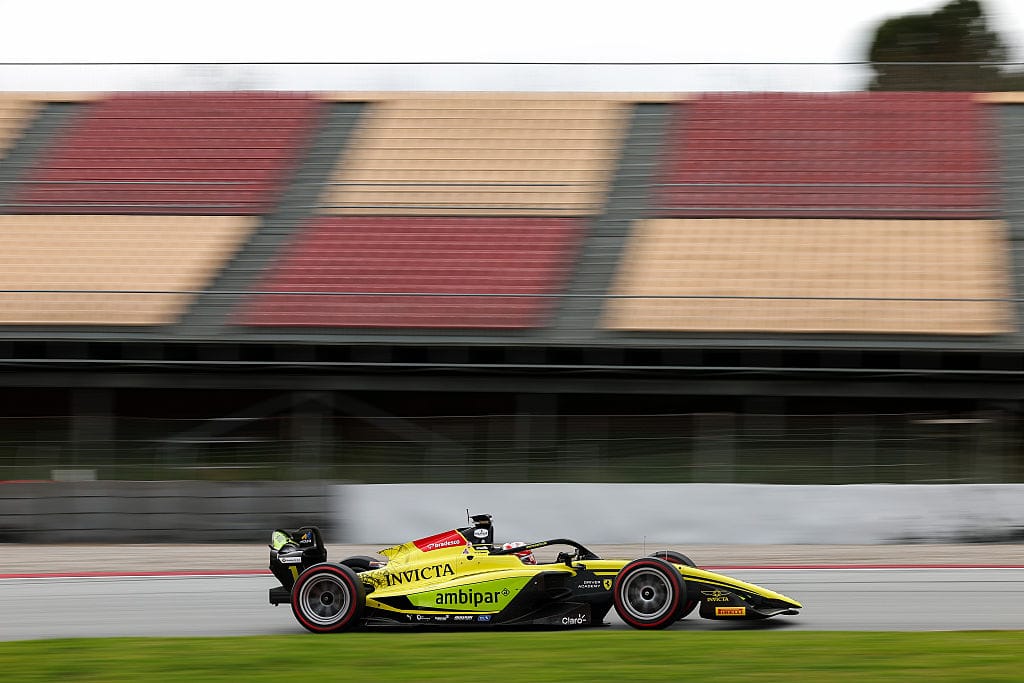
F2…Câmara quickest on final day of testing in Barcelona
Rafael Câmara set the fastest time of the Barcelona test on the third and final morning of pre-season testing for Invicta Racing. The Brazilian’s 1:23.252 was good enough to put him top by a quarter of a second over Campos Racing’s Noel León and Nikola Tsolov, who rounded out the top three when the times were at their quickest.
In the afternoon, Cian Shields led the way for AIX Racing ahead of Campos’ León and teammate Emerson Fittipaldi.
MORNING
Van Amersfoort Racing led the way early on as Rafael Villagómez and then Nico Varrone took turns at the top before Campos emerged from the pitlane.
León secured P1 as he dipped down into the 1:23s, but teammate Tsolov then went quicker, logging a 1:23.654 to lead the field. Approaching the hour mark, the first Red Flag of the day arrived after Varrone got stuck in the gravel at the final corner.
The Argentinian’s car was recovered but another Red Flag waved shortly after, this time teammate Villagómez the one off the road at the last turn.
With his car clear, running resumed only for an immediate Red Flag to arrive, León this time the car stopped on track. His Campos was recovered back to the pitlane and the morning session resumed with just over an hour to go.
Into the final 45 minutes and Câmara delivered the fastest time of the test to that point, logging a 1:23.252 to go comfortably quickest for Invicta. León was able to bring the gap down to 0.274s but nobody could beat Câmara’s effort, leaving the Invicta driver on top of the times once again in a morning session.
Tsolov followed his teammate in third, ahead of Laurens van Hoepen and Gabriele Minì in the top five. Sixth was Colton Herta, just in front of Mari Boya, Ritomo Miyata, Dino Beganovic and Tasanapol Inthraphuvasak in P10.
AFTERNOON
Following the break, race runs began with Hitech taking to the track along with AIX Racing as Miyata took over at the top.
Rodin Motorsport’s Alexander Dunne later moved up to P1 with a 1:29.362, giving him a 0.073s advantage over Câmara in P2. ART Grand Prix emerged from the garage to begin their afternoon running, going 1-2 with Kush Maini leading teammate Inthraphuvasak with a 1:28.582 putting him 0.291s ahead of the Thai driver.
Race running became the focus for the majority of the final afternoon, as teams looked to gather as much data as possible heading to Melbourne. There were a few more improvements late on in the day, with AIX Racing’s Cian Shields going fastest on a 1:26.269, 0.039s ahead of León, who moved himself up to P2 inside the final 15 minutes.
There was one last Red Flag for the day after Laurens van Hoepen stopped on the pit straight, but after his car was recovered, the final minutes elapsed with no further improvements from anyone.
Fittipaldi finished the afternoon third ahead of Herta, Maini, Miyata, Inthraphuvasak, Boya, Camara and van Hoepen in the final top 10 of the test.